
5 hours from now this is gone.

You know that feeling when you almost bought something and didn’t and then thought about it for three weeks?
Yeah.
Don’t do that.
Five copywriting books. $59. Gone in 5 hours. And I mean actually gone (I’ll literally delete the bundle page on Gumroad), not “gone” like those fake countdown timers that reset at midnight.
Your pal,
🚀 Founder Teardwn | Fractional Copy Chief for DTC and eCommerce startups
💌 Newsletter: Creative Samba
🏂 Side projects: 🐶 Goob Hotels + ✍🏼 Nobody Reads Ads + 💭 I’m selling snackablecopytips.com. Make me an offer
One more thing before this disappears.
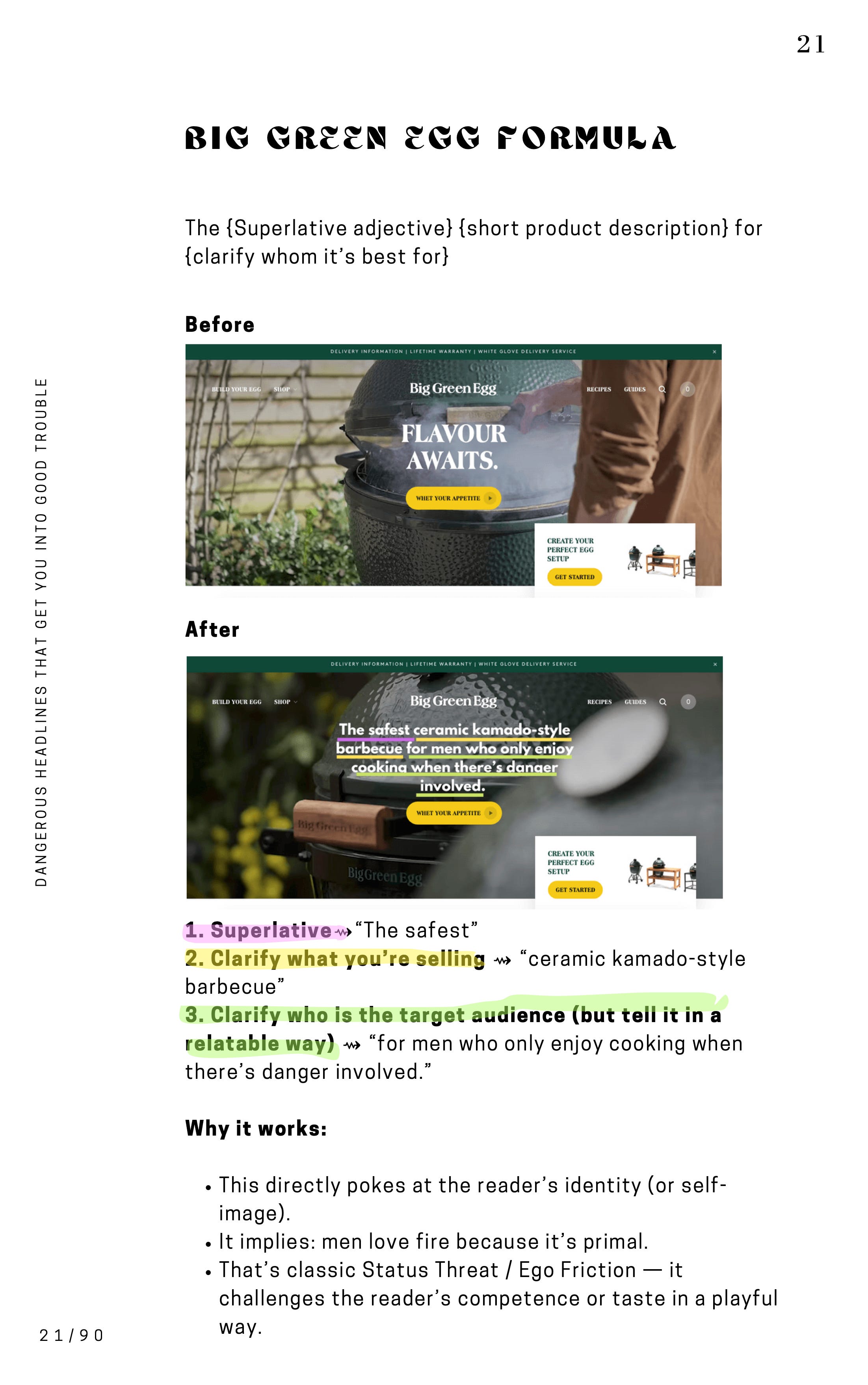
Here’s a free chapter from Dangerous Headlines That Get You Into Good Trouble.
This isn’t another boring copywriting book. This is a playbook for writing headlines humans remember. Anti-boring. Playful. Visceral. The kind AI can’t write.
Read the chapter below. If it makes you want the rest (and the other four books) the bundle is $59 for the next five hours.
The bundle disappears in 5 hours. After that, individual prices. No exceptions and no extensions.
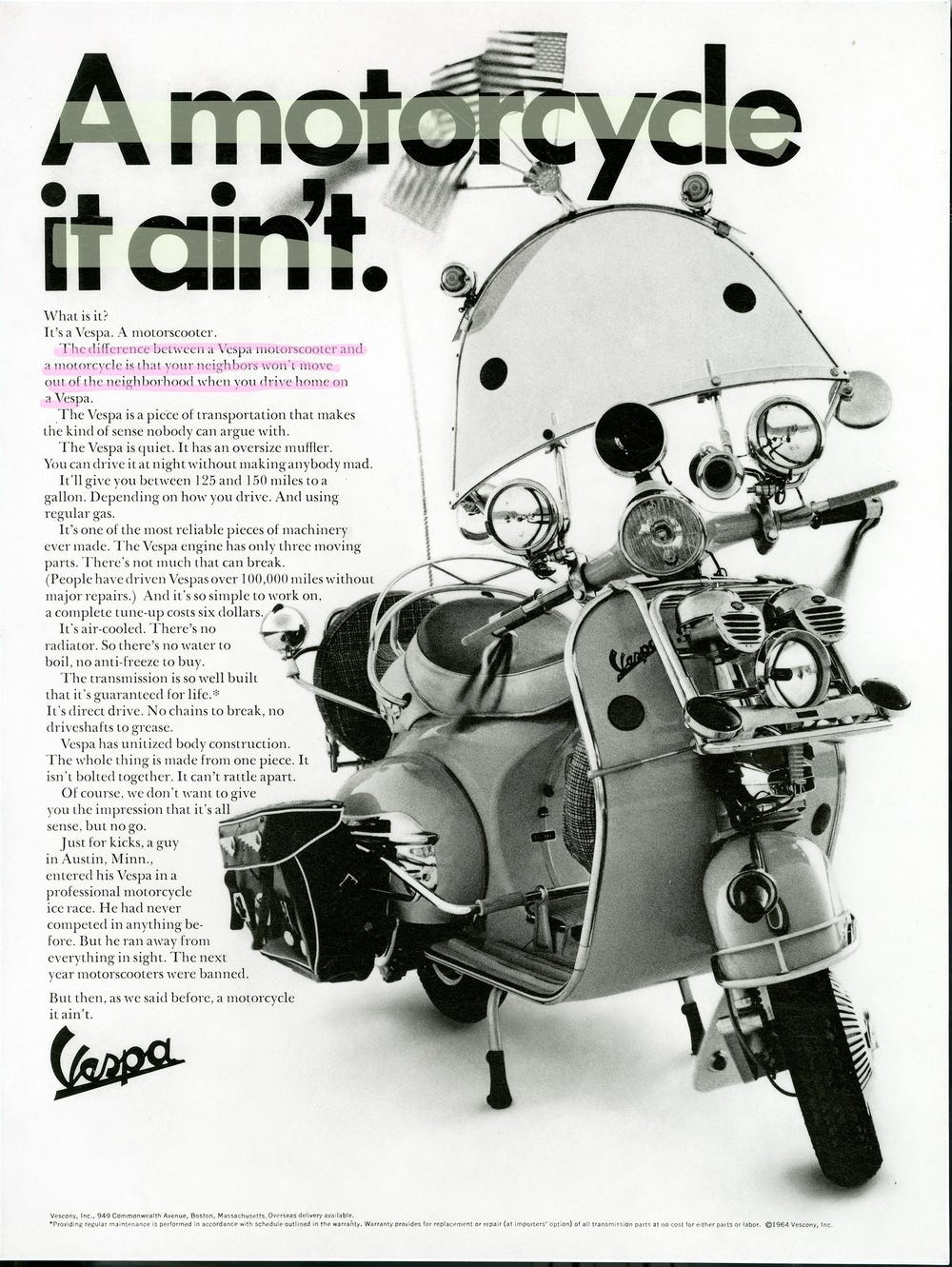
In 1965, Vespa pulled off something most brands are too shy to even dare trying.
Instead of just selling itself, it picked a fight.
The enemy? Motorcycles.
You see, in the 1960s, motorcycles carried certain cultural baggage.
Motorcycles weren’t cool—they were ‘Hide your daughters’ material.
Motorcycles were loud, greasy, and smelled faintly of danger—and probably whiskey.
Which meant the average person in America mostly gave them the side-eye (especially in urban or suburban areas).
Why the bad rep? Blame Hollywood (The Wild One), outlaw gangs like the Hells Angels, and a counterculture that made chaos look irresistible.
Vespa, meanwhile, had evolved from a 1940s novelty into a full-blown cultural icon.
By the mid-1960s, Vespa was no longer a curiosity imported in the 1940s.
Movies like Roman Holiday made it dreamy. The mod movement made it cool. Sales were booming. But despite its urban-cool cred, most people still wrote it off as a tiny toy, not a “real” motorcycle.
Carl Ally’s agency — the same mischief-makers who later made Volvo sexy by admitting it wasn’t — saw an opportunity.
Instead of pretending to be a motorcycle, they declared, “A Motorcycle It Ain’t.” Not an apology. A manifesto, “What is it? It’s a Vespa. A motorscooter.”
The ad turned every reason people hated motorcycles into Vespa’s virtues: no grease, no noise, no neighbors fleeing when you drive home.
It even told an absurd story about a Vespa outrunning motorcycles on ice—proof that it could keep up when it wanted.
Strategically, it’s a masterclass. If you can’t win by being bigger, faster, or louder, don’t try. Invent your own category. And position your brand against a villain.
The villain gives your hero shape. Without the motorcycle — the noisy, antisocial brute — Vespa would just be another piece of Italian metal. With it, Vespa became the civilised rebel.
Dangerous example:
Pick a villain for your brand. It doesn’t have to be a rival brand—or even a product category. Sometimes the villain is a headache your customer hates, an anxiety they can’t shake, or the overpriced option they’re being sold elsewhere. Make your brand the hero that smacks the villain down.
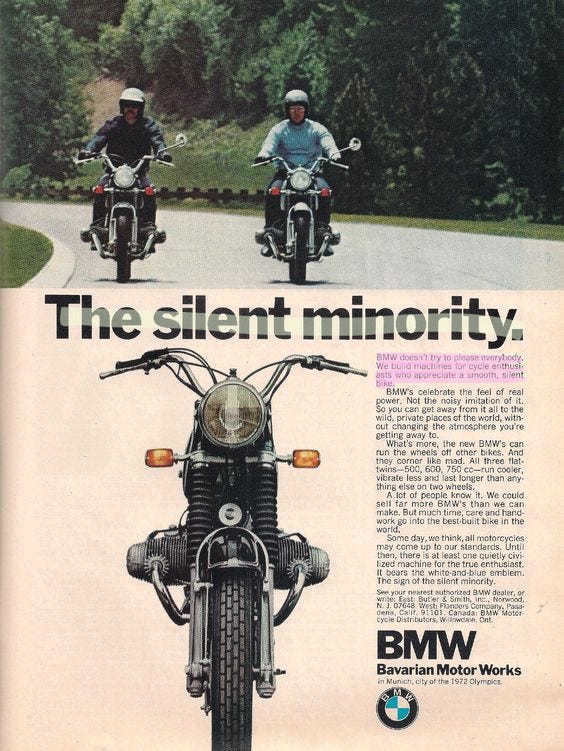
For example, for BMW motorcyles in 1971 the villain was loud, brash, attention-seeking motorcycle culture.
⇝ “The silent minority.”
⇝ “BMW doesn’t try to please everybody. We build machines for cycle enthusiasts who appreciate a smooth, silent bike.”
Dangerous Headline Formula:
My copywriting bundle disappears in 5 hours. After that, individual prices. No exceptions and no extensions.